In this article
Reconcile one purchase without counting a temporary hold twice or treating incoming money as ready to spend.
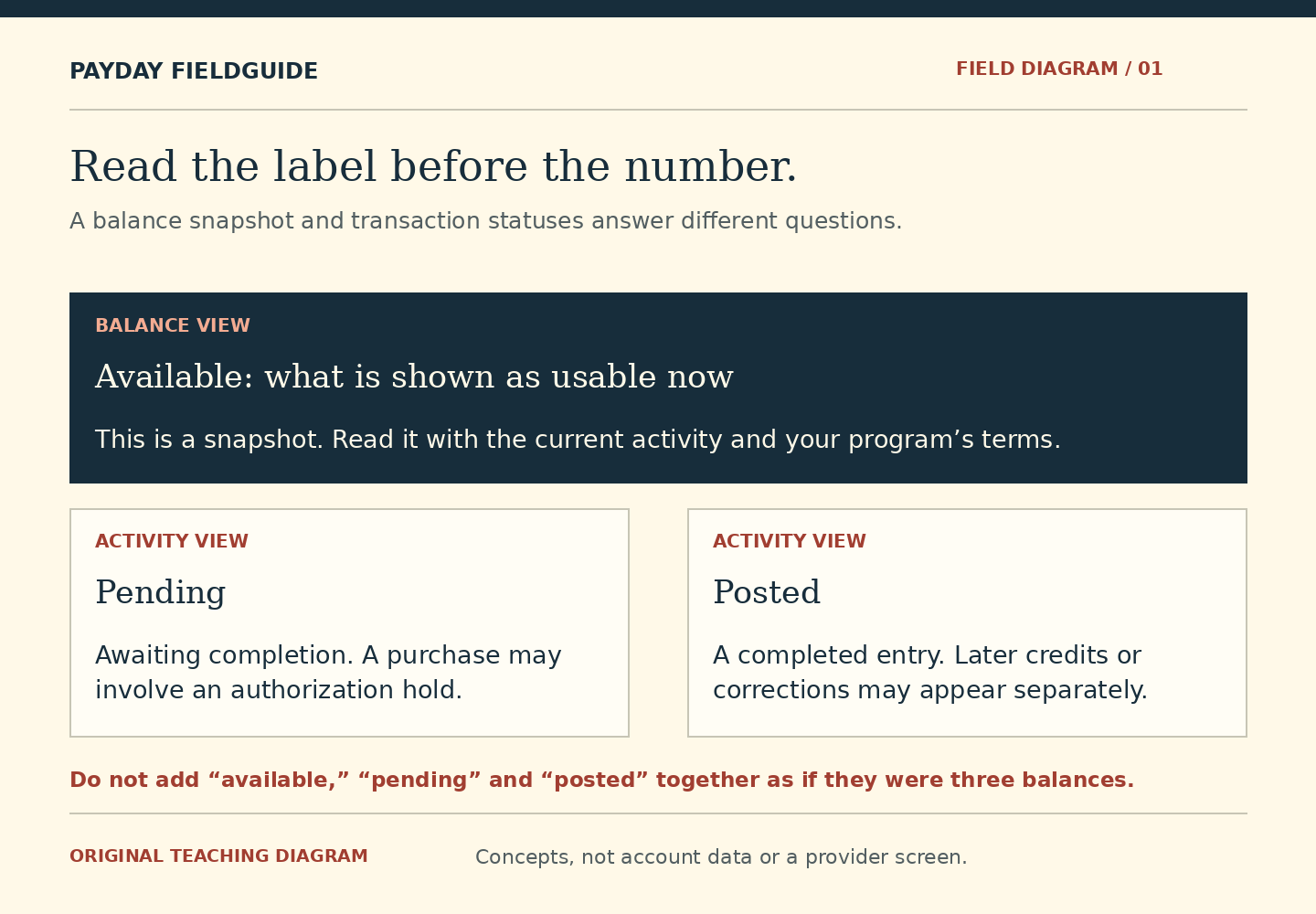
A transaction list is a moving record. Some entries describe money that has finished moving; others describe instructions still being processed. Meanwhile, an available balance answers a practical question about what can be used now. Reading only one of these views can make a normal change look like a missing payment, or make an expected deposit look spendable too soon.
Give each label a separate job
Wisely defines a pending transaction as one that has started but has not fully cleared or settled. A posted entry is no longer merely the initial pending instruction. For planning, keep the transaction’s status next to its amount; an amount copied without its status is incomplete information.
Wisely also explains that pre-authorization holds can temporarily exceed the final purchase at businesses such as fuel stations, hotels and restaurants. Release timing depends on the merchant and processing. This article gives no universal hold amount or expiration time. A receipt and the latest account display are both useful, but they describe different stages.
Walk through a deliberately simple example
Imagine Casey starts with $240 available and makes a fuel purchase. For this exercise, assume a $100 authorization reduces the displayed available amount to $140, even though the final fuel receipt is $38. Those are invented amounts for arithmetic, not a prediction of what a particular station or Wisely program will do.
If nothing else changes and the final $38 purchase replaces the $100 hold, the $62 difference becomes available again. The resulting amount is $202. Casey did not receive a $62 refund for returned fuel; the example instead releases money that had been reserved but was not needed for the final purchase.
A personal notebook could otherwise make the mistake twice: subtract $100 when the hold appears, then subtract another $38 when the final purchase posts. That would report $102 remaining and create an imaginary second purchase. The fix is to connect the authorization and final entry before deciding they represent separate spending.
Use a three-part matching note
- Purchase evidence: merchant, receipt date, purchased amount and any tip or adjustment.
- Account evidence: displayed merchant description, pending or posted status, amount and observation time.
- Open question: what does not match, and what evidence would resolve it?
Do not assume that matching dollar amounts prove matching transactions. Two legitimate purchases may cost the same amount. Conversely, a restaurant authorization and its final tipped total may differ. Use the merchant, dates and receipt together, and keep uncertain matches labeled as uncertain.
Some screens can show information from different processing moments. If a pending line and posted line coexist, that alone does not establish two final debits. Record what you see and ask official support how those entries affect your balance. Avoid repeatedly making a purchase just to test the display; that introduces additional transactions into the question.
Incoming money needs its own check
A pending deposit is not the mirror image of spendable money. Wisely’s deposit-balance FAQ says a pending deposit does not raise the available balance until it posts and clears. Keep an expected paycheck in an “expected” column rather than adding it to today’s spending amount.
Suppose Casey also expects $600 in wages. The budget can show that anticipated income on its expected date while still limiting today’s decisions to confirmed available funds. This preserves both pieces of information without pretending that a visible deposit instruction has already completed.
When the question becomes an error report
If a final charge differs from the receipt, preserve both records and use the transaction-error packet. If an entry is unfamiliar or you suspect unauthorized use, contact the official card provider promptly rather than waiting for a hypothetical hold-release date. The right action depends on whether the issue is processing, a merchant adjustment, or possible fraud.
This method is for Wisely prepaid-card transaction literacy, not a promise about a particular screen or merchant. Your account’s current display and applicable agreement remain the reference. A clean reconciliation ends with either a matched purchase or a clearly documented question; it does not require guessing why a payment system behaved as it did.