In this article
Use a dated cash-flow plan to show which obligations are covered, what is still uncertain and where a low-pay week creates a gap.
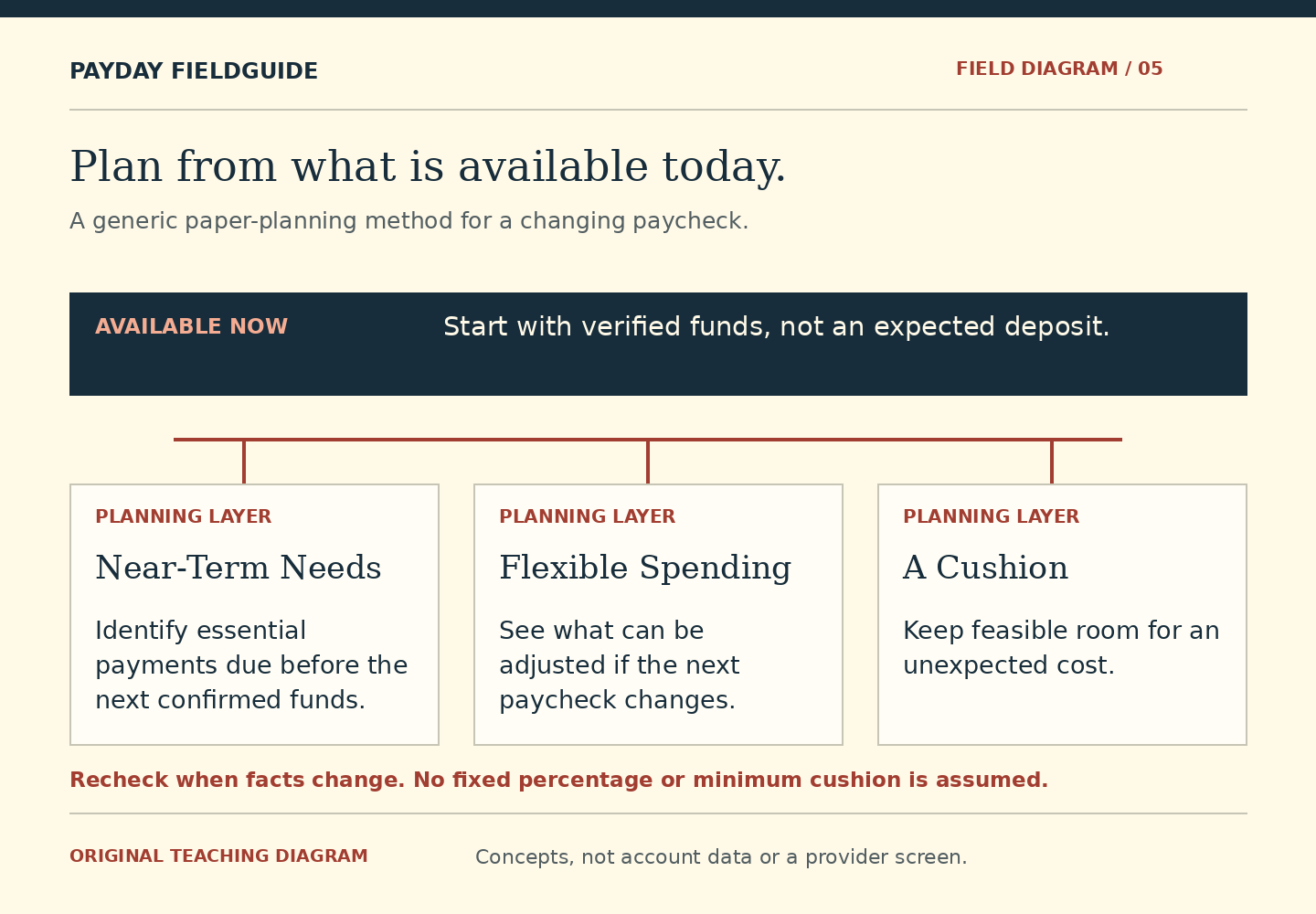
A monthly income average can look comfortable while a bill due next Tuesday remains unfunded. This is especially noticeable when hours, tips, commissions or schedules change. A useful plan for money arriving on a Wisely card needs both amounts and dates. It also needs to distinguish money already available from money you hope to receive.
Start with a real observation window
Gather recent pay statements, deposit records and bills. Mark which payments were ordinary and which included unusual overtime, a one-time bonus or a correction. Avoid treating the largest recent paycheck as the default. The aim is to understand the range your records show, not to predict future earnings with false precision.
The CFPB’s cash-flow budgeting worksheet focuses on when income and expenses occur and carries one week’s ending amount into the next. That timing approach is useful even if you use a notebook rather than the worksheet. Our example below adds explicit uncertainty labels and a smaller paycheck test.
Label the money before assigning it
- Available now: confirmed funds you can currently use.
- Already committed: amounts reserved in your plan for specific upcoming obligations.
- Expected: income with a source and anticipated date that has not yet arrived.
- Uncertain: possible extra shifts, tips or other income without a dependable amount or date.
These are planning labels, not claims about app features or legally separate accounts. They help avoid counting the same dollars as grocery money, bill money and emergency money at the same time. Money can remain physically in one account while your plan explains its intended job.
Work a two-week example
In a fictional plan, Jo has $260 available at the start of the week. Known expenses before the next scheduled payday total $180, leaving $80 if nothing else changes. A paycheck expected the following week is estimated at $520. That second week has $540 of planned bills and essential spending, leaving a projected $60 after adding the carried-over $80.
Now test a lower paycheck of $420. The second week would have $500 available against $540 of planned outflows, a $40 planning gap. That gap exists even though the first week looked positive. Writing both weeks together reveals it before the bill date arrives.
Jo can examine which amounts are fixed, which estimates can be improved, which spending is optional, and whether a biller offers a suitable arrangement. The example does not choose among those options for the reader. It identifies the decision that needs attention. If the plan depends on an extra shift that is not confirmed, mark that dependency openly.
Do not let transfers create imaginary income
Moving $50 from one of your own accounts to another does not increase total household resources by $50. On a combined plan, record the movement between locations without counting it as new earnings. Similarly, a card balance may differ from a personal “available to spend” number because you have assigned some of that money to bills.
For Wisely cardholders using a Savings Envelope, the official FAQ explains that it is part of the account, not an interest-earning savings account. Money placed there no longer appears in the available balance and can be moved back through the official service. Keep that distinction in the plan; do not count the envelope amount both inside and outside the spending total.
Give larger paychecks a deliberate role
When income is higher than the conservative scenario, update the actual figures before making new commitments. Ask which known future expense is not yet covered, whether any delayed obligation remains, and whether a reserve for another low-pay period is possible. A larger deposit can improve the next few weeks without proving that future income has permanently increased.
Conversely, a lower payment is useful information, not a reason to hide the plan. Replace the estimate with the actual amount and recalculate the dates that follow. The point is to keep the picture honest while there is still time to consider options.
Use a short payday review
After each payment, confirm the received amount, mark paid bills, check upcoming due dates and update uncertain income. Keep refunds that have not arrived out of current spending. Use the recurring-payment guide for automatic charges and the split-pay guide if an allocation could help your chosen plan. The useful result is a dated map of commitments and gaps, not an arbitrary budget percentage that ignores your circumstances.