In this article
Follow one paycheck from gross earnings to net pay and payment allocation before deciding where a discrepancy belongs.
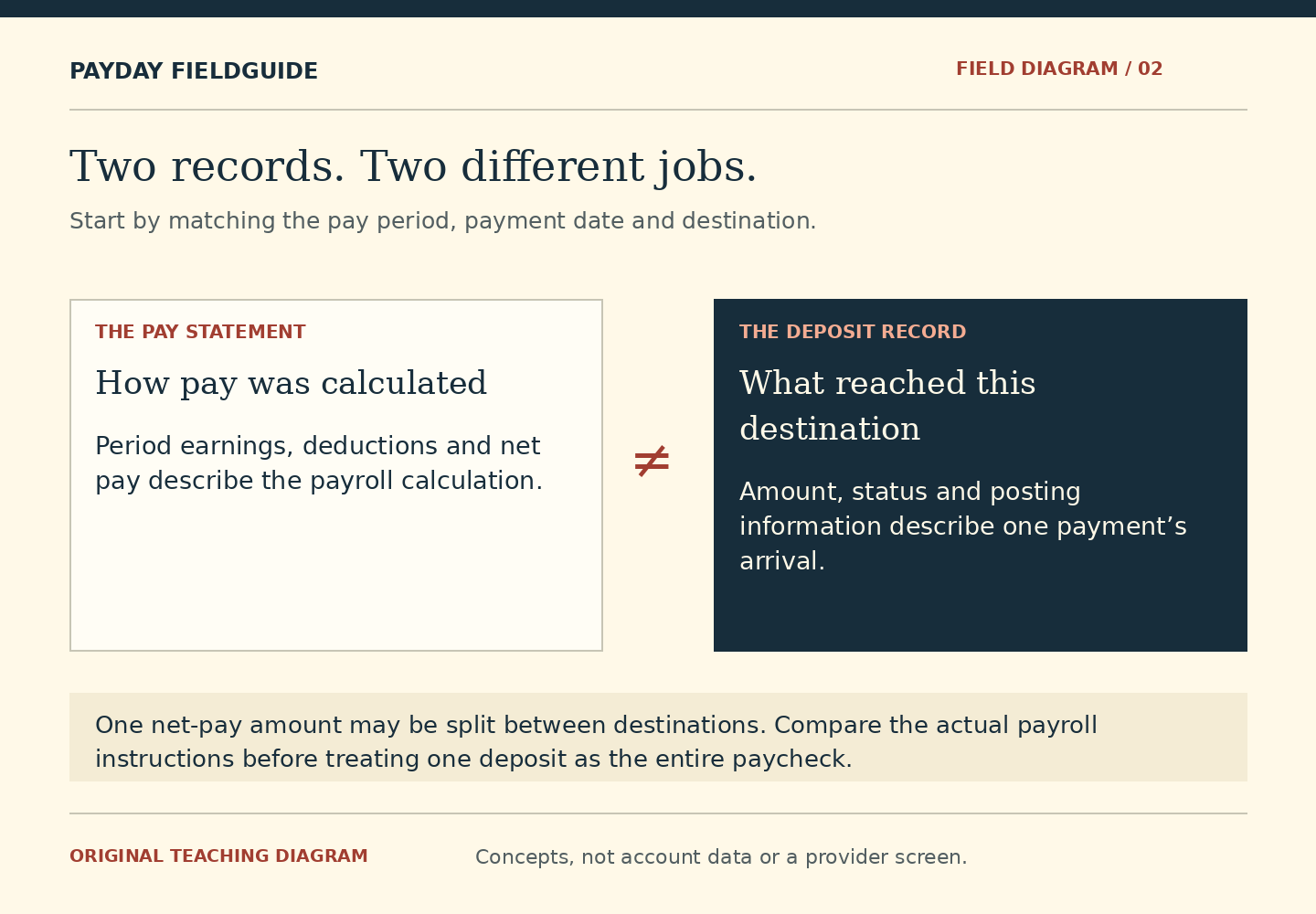
A deposit tells you how much money arrived in one place. A pay statement explains how an employer calculated a payment. When the two totals differ, first ask whether you are comparing the same payment and the same kind of number. “My paycheck is short” may describe several distinct problems, each needing a different record and a different question.
Start with the statement’s dates
Write down the pay-period start and end dates, the payment date, and the employer named on the statement. Then find the deposit associated with that payment. Do not substitute the day you worked a shift for the statement’s payment date, or compare one recent deposit with a year-to-date total.
ADP’s pay-stub explainer distinguishes earnings before deductions from take-home pay after deductions. Its description is general payroll education. It does not mean every employer uses the same statement layout, deductions, pay codes or access system.
Use four numbers in order
- Gross earnings: the statement’s earnings total before the relevant payroll deductions.
- Employee deductions: the amounts actually taken from this payment, using the labels on the statement.
- Net pay: the resulting take-home amount shown for the payment.
- Payment allocation: the part assigned to Wisely, another account, or another payment method.
Copy the labels carefully. An employer contribution displayed for information is not automatically another deduction from your wages. A year-to-date figure is not automatically the amount withheld this time. If a line is unclear, ask payroll what it means instead of forcing it into your arithmetic.
A difference that reconciles
Here is a fictional, simplified payment. Morgan’s statement shows $900 in gross earnings and $150 in combined employee deductions, leaving $750 in net pay. The authorized allocation sends $200 to a separate account and the remaining $550 to Wisely. A $550 Wisely deposit is consistent with that allocation even though it is $350 below gross pay.
The $350 difference has two explanations: $150 of deductions and $200 directed elsewhere. Neither category should be described as money “taken by the card.” This example does not validate the deductions themselves; it only locates them in the chain. Morgan would still need to review any deduction that was unexpected or incorrectly calculated.
A difference that remains open
Now suppose the allocation still calls for $550 to Wisely, but the identifiable deposit is $530. That leaves a $20 question. Morgan records the statement date, net pay, allocation amount, deposit description and received amount. The inquiry becomes: “This statement allocates $550 to this payment destination, while the matching deposit appears to be $530. Can you confirm the amount sent?”
It would be a mistake to compare $550 with the current available balance after buying lunch or moving money. Reconcile the deposit entry itself. Spending after arrival affects the balance without changing the original deposit amount. Likewise, several deposits from different employers should not be combined until each has been matched to its own statement.
Route the question to the record owner
Payroll or HR can explain hours, pay codes, deductions, the scheduled payday and payment instructions. The card provider can help with the card account’s received transaction and status. Wisely’s direct-deposit guidance directs cardholders through their employer’s setup process and distinguishes account information from the card number. Receiving pay on Wisely does not establish where your employer keeps pay statements.
For a missing deposit, ask payroll to confirm the destination using a secure channel and only the identifying details needed. Do not put full routing and account numbers into a public comment, screenshot or informal group chat. If payroll confirms transmission, retain any reference they provide for the official support conversation.
Finish with a repeatable check
Keep one private folder or note per questioned payment. Save the original statement, a redacted copy for routine discussion, and the exact question still open. If a correction arrives later, record it separately and match it back to the original period. A later adjustment should not quietly rewrite the historical record.
Use the split-deposit worksheet method if allocation caused the confusion, or the deposit-timing guide if the amount is correct but arrival is uncertain. The goal is a traceable explanation, not a conclusion about tax treatment, legal entitlement or an employer’s motives based on one screen.