In this article
Separate the scheduled payday, payroll transmission and funds availability so you can ask the right question about a delay.
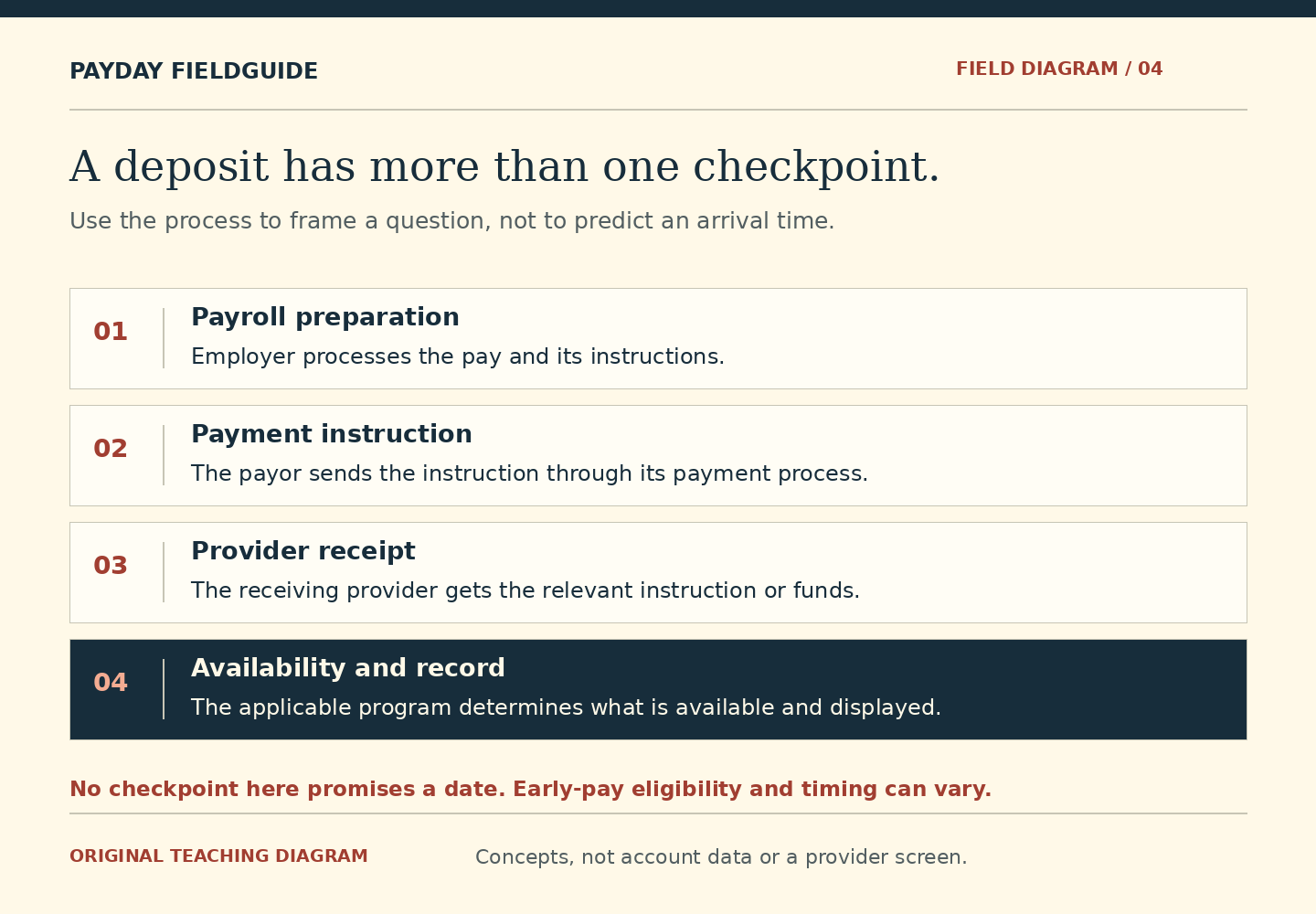
“It usually arrives Wednesday” is a useful observation, but it is not the same as an employer’s scheduled payday. When a Wisely deposit arrives later than a previous one, start by separating the dates people are talking about. That helps distinguish a changed early-arrival pattern from a payment that has missed its expected payroll date.
There are three clocks to identify
- Payroll date: when the employer says the payment is due under its schedule.
- Transmission: when the payer sends the payment instructions and whether those instructions are correct.
- Availability: when funds become usable in the receiving account.
You may be able to observe the third event directly while needing payroll to confirm the first two. An app notification does not expose the entire payment chain. The absence of a familiar alert is also not enough to identify the cause of a delay.
Read early-pay language with its conditions attached
Wisely’s direct-deposit disclosures say early availability requires opt-in, is not guaranteed, and depends on the payer’s support and timing of instructions. They also advise allowing up to three weeks after initial setup for funds to begin loading. That setup allowance is not a universal explanation for every later missing paycheck.
For planning, treat a previous early arrival as historical information. Do not turn it into an exact weekday, hour or guaranteed lead time for future payments. A statement such as “up to” describes a possible maximum benefit under conditions; it does not establish that every payment will receive it.
Choose the branch that fits your situation
New or recently changed instructions: confirm that payroll received the change, which cutoff applied, and which payment is expected to use it. Ask whether the previous destination or another payment method was used during the transition. Repeatedly replacing instructions before understanding the first change can make the record harder to follow.
An established deposit arriving later than usual: compare the scheduled payday with the date you are checking. Ask whether payroll sent this payment normally. If you are only comparing with an earlier-than-scheduled arrival from last time, describe that accurately rather than reporting a missed scheduled payday.
A pending entry that remains unresolved: retain its amount, description, status and observation time. Wisely’s pending-deposit guidance recommends verifying the employer’s transmission first and then contacting Wisely when needed. Possible causes listed publicly are possibilities, not a diagnosis of your account.
A calendar example
In a fictional example, Taylor’s employer identifies Friday as payday. The last two deposits became available on Wednesday. This week, no deposit is visible Wednesday afternoon. Taylor has noticed a change in early timing, but has not yet established that Friday’s scheduled payment is late.
Taylor’s useful question to payroll is, “Is the Friday payment scheduled normally, and have the deposit instructions been sent?” If payroll instead says the payment was held for correction, Taylor now has a concrete issue and a contact responsible for the next update. If payroll confirms the sent amount and destination, those facts support the official card-provider inquiry.
Include holidays without blaming them automatically
Wisely’s holiday FAQ says holidays can affect processing depending on when instructions are received. Check the actual dates relevant to the payment and ask about the employer’s holiday schedule. A nearby holiday is not proof that it caused a particular delay, and a generic calendar cannot confirm when your employer submitted payroll.
Record times with a time zone if people in different locations are involved. “Sent yesterday” can create confusion when one person means the payroll file was prepared and another means it was accepted for processing. Ask what the status describes rather than arguing from the word alone.
Keep a small escalation record
- Scheduled payday, pay period and expected allocated amount
- Date any deposit instructions changed and submission confirmation
- Payroll’s confirmed transmission status and reference, if supplied
- Visible account status, checked date and time
- Official support case reference and the next agreed check
Share account details only through verified secure channels. While the issue remains open, base spending on funds actually available and review near-term bills using the payment-buffer method. The aim is to establish the next accountable step and a reliable update point, rather than repeatedly refreshing a screen or accepting an unsupported promise about when money will appear.