In this article
Separate the machine owner’s surcharge from your card’s fees and compare practical cash-access options before withdrawing.
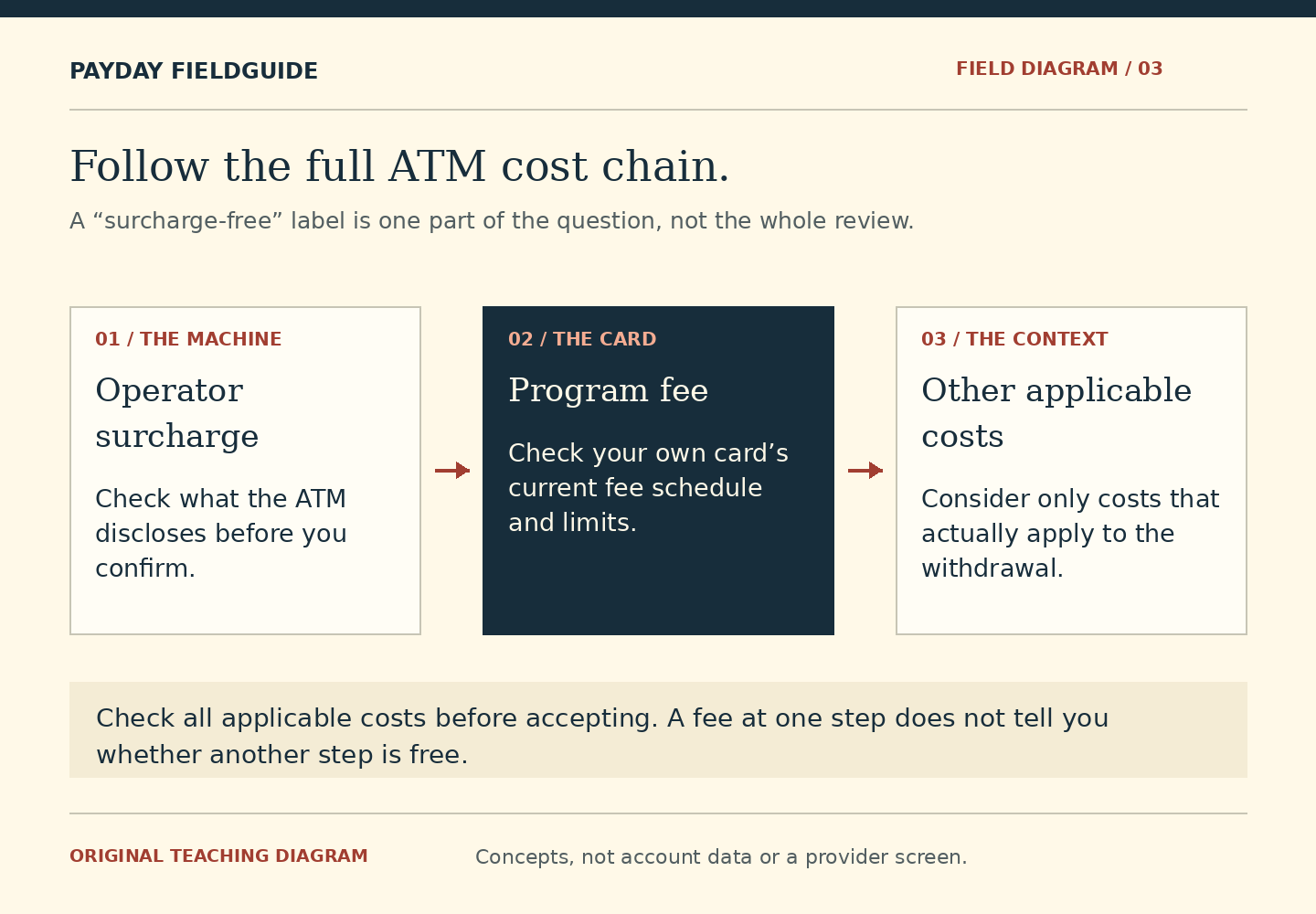
A sign saying “surcharge-free” answers one fee question. It does not necessarily answer every cost question associated with getting cash. For a Wisely cardholder, a better approach is to trace the withdrawal from the machine’s terms to the card’s own fee schedule, then include any practical cost of reaching the machine.
The two fees people often combine
Wisely’s surcharge-free ATM explanation distinguishes the ATM’s charge from a possible transaction fee under the card program. Its surcharge definition likewise treats the machine owner’s fee as separate. A waived surcharge therefore does not prove that the full transaction costs zero.
Use the fee schedule for your actual program, rather than a dollar figure from a review or coworker. Wisely’s fees directory directs cardholders to their agreement and applicable list of fees. Benefits, limits and charges can differ; this article intentionally provides no universal Wisely withdrawal price.
Build a short decision before leaving
- How much cash is needed, and when?
- Which nearby machines appear in the current official locator for the card?
- What does the applicable schedule say about this type of withdrawal?
- Do any transaction-count limits or other conditions affect the quoted benefit?
- Will travel, opening hours or a required purchase change the practical choice?
The official locator is more useful than a remembered network sticker. A machine inside a locked store is not useful after closing. A nearby machine may also dispense denominations that do not fit the exact amount needed. Check the details that can turn an apparently cheap option into a second trip.
Compare two invented routes
Suppose Riley needs $60 in cash. In this fictional example, Machine A would impose a $3 owner surcharge and the relevant card transaction charge would be $2. The cash withdrawal reduces the account by $65: $60 received plus $5 in charges. These figures are made up to illustrate the calculation and are not Wisely’s fees.
Machine B has no owner surcharge, and assume the applicable program permits this particular withdrawal without a card transaction fee. It appears to save $5. But if reaching it requires a separate $4 round-trip fare, the immediate cash-cost difference is only $1. If Riley passes it during an already planned journey, that extra travel cost may disappear.
This is a comparison framework, not a directive to choose either machine. Safety, accessibility and the urgency of the cash need matter too. Carrying more cash to reduce the number of withdrawals may create a different risk. The best amount cannot be inferred from a fee alone.
At the machine, read before accepting
Compare any displayed fee with the expectation you formed. If the machine presents an unexpected surcharge and you do not want to accept it, stop before authorizing the withdrawal and consider another option. Do not assume that an independent article or locator guarantees reimbursement for a fee you accept.
Make sure the chosen amount leaves room for applicable charges and existing commitments. Available balance, the card’s limits, and the ATM’s own limits are separate constraints. A decline is not a reliable way to discover which one applies. Avoid a string of repeated attempts; instead use the official help route if the reason remains unclear.
Keep the receipt useful
For an ordinary completed withdrawal, match the cash received, withdrawal entry and any separate fee entry. If the machine dispenses the wrong amount or no cash despite an account debit, record the date, time, location, machine identifier if visible, requested amount, cash actually received and receipt message. Photograph only nonsensitive information if doing so is safe.
Do not leave a receipt containing account details beside the machine. Preserve it privately and promptly contact the official provider about a suspected error. The error-record guide explains how to turn those observations into a clear report without diagnosing the machine yourself.
Make the comparison reusable
Save a small list of convenient verified locations, the date you checked them and the circumstances under which they were useful. Review it when your card program, routine or fee schedule changes. A good cash-access plan is a current comparison of your actual options, rather than a permanent promise that a particular logo always means free cash.